
Let’s just say it plainly, again, because this is where most people get confused about how to build muscle at home.
Not everyone wants a gym.
Some people hate the mirrors.
Some hate the crowds.
Some hate the monthly fees that quietly drain their bank account.
Some don’t want to wait for a bench while scrolling their phone pretending they’re not annoyed.
And some people just want to train in peace. At home. On their own terms.
So the question keeps coming back, louder every year:
Can you actually build muscle at home without equipment?
Not “get a pump.”
Not “feel active.”
Not “burn calories.”
Real muscle. Real strength. Real physical change.
And the answer is still the same:
Yes.
But only if you stop lying to yourself about what training actually requires.
Why the “No Equipment” Question Is the Wrong Question
Here’s the problem.
Most people ask, “Can I build muscle without weights?”
What they should be asking is:
“Can I challenge my muscles enough, consistently, to force adaptation?”
Because muscle doesn’t understand dumbbells.
It doesn’t recognize gym memberships.
It doesn’t care if your workout looks impressive on Instagram.
Muscle only responds to stress.
Tension.
Fatigue.
Effort near failure.
That’s it.
The reason gyms work isn’t because of machines.
It’s because machines make it easy to apply progressive overload.
At home, you have to be more intentional.
More aware.
More honest with yourself.
That’s where most people fail.
Why Most Home Workouts Don’t Build Muscle
Let’s call it out.
Most home workouts fail because they’re treated like fillers.
Something you do when:
- You don’t have time
- The gym is closed
- You’re “just trying to stay active”
That mindset kills progress before it starts.
People do:
- The same 15-minute routine
- The same number of reps
- The same exercises
- With the same effort
For weeks.
For months.
Sometimes for years.
Then they say, “Bodyweight training doesn’t work.”
No.
Underloading doesn’t work.
The One Rule You Cannot Break If You Want to Build Muscle at Home
If nothing else comes to mind, keep this in mind:
Your muscles must be pushed close to failure.
Not exhaustion.
Not sweating.
Not boredom.
Failure or very close to it.
That means the last few reps should feel slow.
Uncomfortable.
Shaky.
Questionable.
If you finish every set feeling fresh, you’re not training.
You’re moving.
This rule applies whether you’re lifting 100 kg or doing push-ups on your bedroom floor.
What “Build Muscle at Home” Actually Looks Like in Real Life
It’s not cinematic.
It’s not aesthetic.
It’s not always fun.
Sometimes it looks like:
- Pausing at the bottom of a squat while your legs shake
- Slowing down a push-up when your arms want to collapse
- Holding a plank longer than your brain wants to tolerate
- Repeating a set even when you want to quit early
That’s where muscle is built.
Not in motivation.
Not in perfect conditions.
But in controlled discomfort.
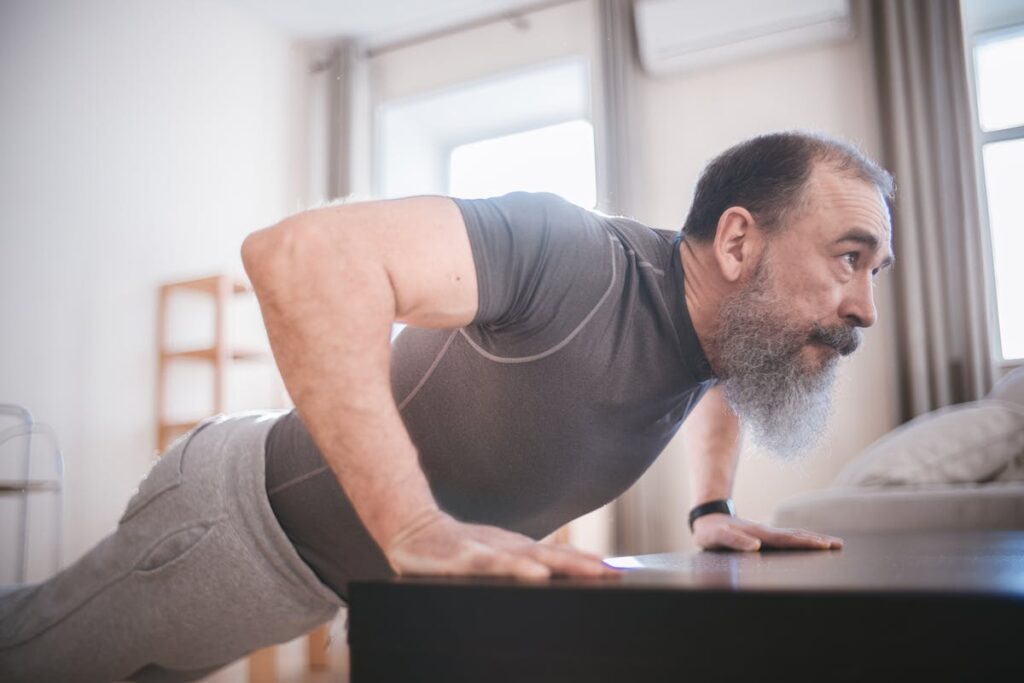
Push-Ups Can Help You Gain Muscle at Home (And Why Most People Waste Them)
Push-ups are not given the respect they deserve.
They aren’t beginner exercises.
They’re scalable resistance tools.
Most people ruin them by rushing.
They bounce.
They shorten the range.
They let hips sag.
They chase numbers instead of tension.
That’s why they plateau fast.
How to Make Push-Ups Build Real Muscle at Home
Slow the descent.
Pause near the floor.
Drive up with intent.
Brace your core like it matters because it does.
Now suddenly, 12 reps feels like 25.
And once that becomes manageable, you don’t abandon push-ups.
You upgrade them.
Feet elevated.
Hands staggered.
Archer variations.
Tempo work.
Mechanical drop sets.
One push-up variation can last you months if you respect it.
Build Muscle at Home With Squats (And Why Bodyweight Squats Get Mocked)
Bodyweight squats are mocked because they’re done lazily.
Half depth.
No control.
No tension.
No intent.
That’s not a squat.
That’s a knee bend.
A real squat, even with no weight at all, is harder than people expect once you actually slow it down and go deep.
How Squats Stimulate Muscle Without Weights
Depth increases tension.
Tempo increases difficulty.
Single-leg work doubles the load instantly.
When you pause at the bottom of a squat for three seconds, your legs don’t care that there’s no barbell.
They care that they’re under stress.
And stress equals growth.
Single-Leg Training: The Home Workout Cheat Code
If there’s one thing that separates effective at-home muscle building from wasted effort, it’s this:
Unilateral training.
One leg.
One side.
One limb at a time.
Why it works:
- Doubles relative load
- Exposes weaknesses
- Improves balance
- Forces core engagement
Bulgarian split squats alone can build legs that look trained, not “active,” but trained.
They’re uncomfortable.
They’re humbling.
They work.
Build Muscle at Home With Lunges (Why They Feel So Brutal)
Lunges feel harder than squats for a reason.
They demand stability.
They demand control.
They punish imbalance.
And that’s exactly why they’re effective.
Your body must simultaneously produce force, stabilize, and control movement during each repetition.
At home, that’s gold.
Add pauses.
Add slow negatives.
Add jump transitions.
Your legs will respond.
Build Muscle at Home With Dips (Upper Body Without Weights)
Dips get ignored a lot, mostly because people think they’re inconvenient. In reality, if you’ve got a chair or a couch nearby, that’s already enough.
Dips load the triceps heavily and strong triceps matter more than most people realize.
They assist:
- Push-ups
- Pressing movements
- Shoulder stability
And they respond quickly to progressive overload.
Slow them down.
Increase reps.
Elevate feet.
Your arms will change.
Core Training at Home: What Actually Works
Forget endless crunches.
Your core’s primary job is stability, not flexion.
That’s why planks work when done correctly.
A plank should feel like work.
If it feels relaxing, you’re missing the point.
Brace.
Breathe under tension.
Fight the urge to quit early.
Advanced Core Work Without Equipment
Side planks challenge lateral stability.
Hollow holds teach full-body tension.
Plank transitions add dynamic control.
A strong core makes every other movement better.
That’s not theory, it’s noticeable in weeks.
How Often Should You Train to Build Muscle at Home?
More is not always better.
Three to five sessions per week is enough.
Sometimes more than enough.
What matters is:
- Effort
- Progression
- Recovery
Training every day with low intensity does less than training four days with purpose.
Progressive Overload Without Equipment (The Real Strategy)
This is where most articles get vague.
So let’s be specific.
You progress by:
- Adding reps until sets become uncomfortable
- Slowing tempo, especially on the negative
- Adding pauses at weak points
- Switching to harder variations
- Reducing rest time strategically
Making all the adjustments at once is not required.
One variable is sufficient at a time.
That’s how you build muscle at home long-term instead of burning out.
Nutrition: The Quiet Reason You’re Not Growing
You can train perfectly and still fail to build muscle.
Why?
Because muscle is built from food.
Training is the signal.
Food is the material.
If the material isn’t there, nothing gets built.
Protein Is Non-Negotiable
You don’t need obsession.
You need consistency.
Protein at every meal.
From real food when possible.
Eggs.
Chicken.
Fish.
Dairy.
Legumes.
Miss it occasionally.
Don’t miss it daily.
Calories Matter More Than You Think
Your body favors survival over growth when you are eating less.
That’s biology.
At home or in the gym doesn’t matter.
Eat enough to recover.
Eat enough to progress.
Recovery: The Most Ignored Muscle-Building Tool
Hydration is not optional.
Rest days are not laziness.
Muscle grows during recovery.
Training just starts the process.
Ignore recovery and progress slows, then stops.
Mental Discipline: The Real Difference
Here’s the part no one likes to hear.
At home, there’s no external pressure.
No mirrors.
No people watching.
No gym energy.
It’s just you.
Which means discipline matters more.
You decide whether to stop early.
You decide whether to push harder.
You decide whether to show up.
That’s why building muscle at home builds more than muscle.
It builds self-control.
Common Mistakes That Keep People Small at Home
- Doing workouts randomly
- Never tracking progress
- Avoiding hard variations
- Skipping legs
- Under-eating
- Sleeping poorly
Fix those and progress accelerates.
So Yes, You Can Build Muscle at Home
Not hypothetically.
Not “in theory.”
Actually.
Visibly.
Measurably.
Sustainably.
But only if you stop treating home workouts like placeholders.
They’re not.
They’re tools.
Powerful ones.
If you use them properly.
Final Thoughts: Build Muscle at Home, Without Needing Permission
You don’t need a gym to start.
You don’t need equipment to grow.
You don’t need perfect conditions.
You need effort.
Consistency.
And patience.
That’s it.
Start with what you have.
Progress slowly.
Push honestly.
Eat properly.
Recover fully.
And over time, the question stops being “Can I build muscle at home?”
Because the answer will be standing in the mirror.
Frequently Asked Questions About Not Losing Weight
What are the best exercises to build muscle at home without equipment?
Bodyweight exercises like push-ups, squats, lunges, planks, and dips work major muscles without equipment. These moves progressively challenge your body and, when done regularly with proper form, can stimulate muscle growth.
How often should I train to build muscle without equipment?
Train 3–4 times per week with at least one rest day between sessions. Consistency and progressive overload such as increasing reps, slowing movements, or varying exercises help your muscles adapt and grow.
Can bodyweight training really build significant muscle without weights?
Yes. Bodyweight training can build muscle effectively if you apply progressive overload making exercises harder over time through variations or increased time under tension. Many athletes and fitness experts agree it’s a viable way to stimulate hypertrophy.
Should I focus only on workouts if I want to build muscle at home?
No. Nutrition and recovery are equally important. Eating enough protein and calories, staying hydrated, and getting proper rest help repair and build muscle tissue after workouts.
How long does it take to see results from bodyweight muscle training?
Results vary by individual, but most people notice increased strength and muscle definition within 4–8 weeks of consistent training and proper nutrition. Patience, progressive overload, and recovery are key.
What mistakes slow progress when building muscle at home?
Common mistakes include inconsistent workouts, poor exercise form, lack of progressive challenge, inadequate nutrition, and insufficient rest. Fixing these helps your muscles adapt and grow more efficiently.
Do push-ups and squats really help build muscle without equipment?
Yes. Push-ups target the chest, shoulders, and triceps, while squats build the legs and glutes. Variations like slow-tempo push-ups or one-leg squats increase muscle activation and challenge.
This article is for educational purposes only and reflects general training and nutrition principles used by fitness professionals. It is not a substitute for personalized medical or fitness advice.
Super motivating! Love how doable this makes building muscle at home feel—no excuses now. Thanks for the clear tips!
Pingback: Home Workouts VS Gym Workouts: Which Is Better for You?
Pingback: Unlocking Flexibility: The Best Lower Back Stretches for Daily Relief - Let fit it
Pingback: Lower Chest Exercises: The Ultimate Guide to Defining Your Pecs
Pingback: How to Lose Weight in Your Face: Practical Tips
Pingback: How to Read Nutrition Labels Like a Pro
Pingback: Superfoods For Energy That Boost Your Performance -
Pingback: Vegetarian Bodybuilding: Build Muscle Without Meat
Pingback: How to Improve Grip Strength: A Guide to Stronger Hands